
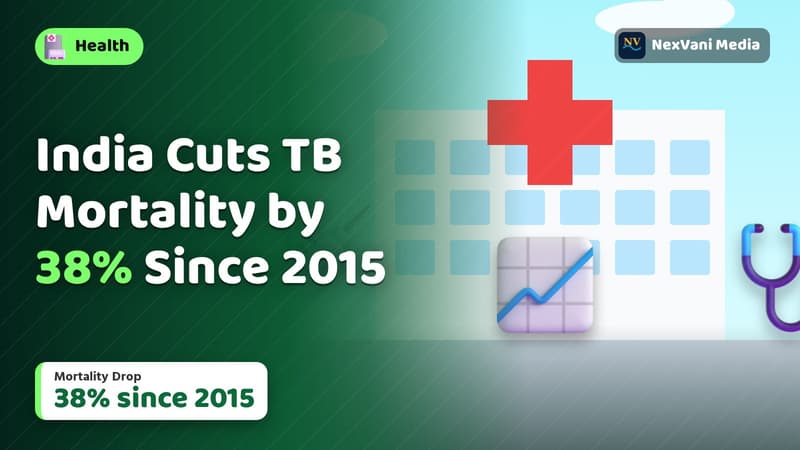
India Cuts TB Mortality by 38% Since 2015, Says WHO Report
Illustration: NexVani Media
India has achieved a 38% reduction in tuberculosis mortality and a 94% treatment success rate, marking significant progress in the national mission to eliminate the disease.
India has marked a significant milestone in public health as the World Health Organization’s (WHO) Global Tuberculosis Report 2026 confirms a 38% decline in TB mortality since 2015. While global rates have fallen by 35%, India’s performance stands out, with the mortality rate dropping from 28 per lakh of the population in 2015 to 18 per lakh in 2025. As citizens often look to see India who is leading these health initiatives, the government has credited this success to a comprehensive, multi-pronged strategy under the National TB Elimination Programme (NTEP).
India has reduced TB mortality by 38% since 2015, achieving a 94% treatment success rate for patients.
Advancing Public Health
The health ministry stated that the report utilized diverse data sources, including the Ni-kshay portal and sample registration systems, to ensure accurate mortality estimations. Central to this success has been the 'Jan Andolan' approach, which has mobilized government agencies, private healthcare providers, and community leaders. The initiative has been bolstered by technological innovations, including AI-enabled X-rays for hotspot identification, the Khushi-AI Chatbot, and the deployment of Avatar Videobots to enhance patient engagement.
Between December 2024 and November 2026, the country conducted over 11 crore chest X-rays, identifying 48.64 lakh new cases. Notably, this included nearly 15 lakh asymptomatic patients who might otherwise have gone undiagnosed. The high treatment success rate of 94% for drug-susceptible TB reflects the efficacy of the Ni-kshay Poshan Yojana, which provides nutritional support, and the Ni-kshay Mitra initiative, which encourages citizens to support those undergoing treatment.
Grassroots Participation
India’s commitment to TB elimination is further evidenced by the fact that 96% of the program's funding is sourced domestically. The mission has expanded through intensified 100-day campaigns, reaching high-priority districts and vulnerable populations in villages and urban wards. Youth involvement is also growing through the JOSH Teams initiative, which integrates NCC cadets and MY Bharat volunteers into local-level efforts. Additionally, the declaration of 67,933 panchayats as TB-free in 2025 highlights the success of community-led interventions.
Why it matters
This progress represents a major shift in the management of infectious diseases in South Asia, moving toward a 'TB-Mukt Bharat' or TB-free India. By integrating AI diagnostics and community-based screening, the program effectively reaches vulnerable populations, ensuring that early detection and nutritional support are accessible to those in need, ultimately saving lives across the country.
Sources
More like this
Gaza Doctor Killed in Hospital Strike as Healthcare System Faces Horrific Conditions
Medical Charity Warns Millions Ebola Funds Are Missing Amidst Outbreak

NHS England Removes Claim That 137 Hospitals Benefit From Palantir AI Tools
