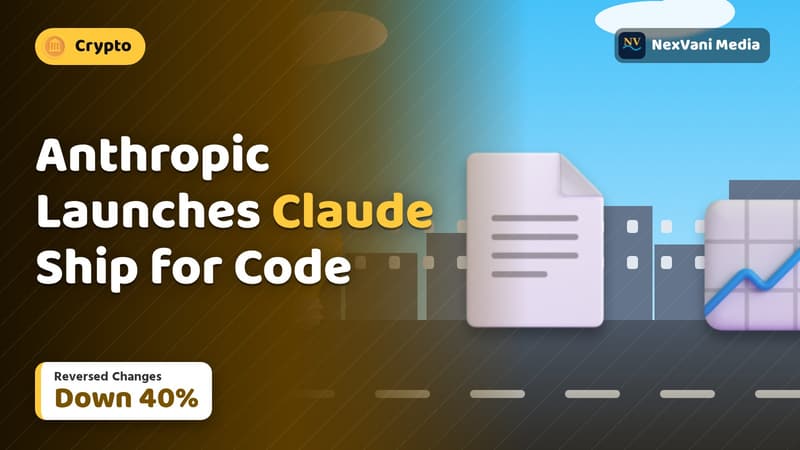
Anthropic Launches Claude Ship to Automate Software Code Reviews
Illustration: NexVani Media
Anthropic has introduced Claude Ship, a suite of AI agents designed to review, repair, and approve software code, potentially allowing automated updates to company codebases.
This is news, not investment advice. NexVani Media is not a SEBI-registered investment adviser and does not recommend buying or selling any security. Do your own research or consult a registered adviser before investing.
Anthropic has unveiled a new collection of AI tools known as Claude Ship, designed to automate the critical stages of software engineering where AI-generated code is reviewed and approved. As developers increasingly rely on Anthropic Claude AI to write software, the process of verifying that code has become a significant bottleneck. Claude Ship aims to address this by delegating the review and approval process to autonomous agents.
Understanding Anthropic Claude Ship
The system is composed of three distinct tools. The first, Code Review, utilizes multiple agents to scan proposed changes against an existing codebase, identifying potential bugs and verifying the findings of other agents. The second tool, PR Steward, automatically applies corrections when tests fail or reviewers find issues, while documenting its actions so developers can intervene if necessary. Finally, Claude Approvals decides if the proposed changes meet specific company policies. Depending on internal configurations, this can allow software changes to be merged into a repository without human intervention.
While this automation is intended to streamline development, it introduces new challenges. Anthropic noted that AI agents can sometimes get stuck in loops, citing an instance where a change underwent over 50 rounds of automated review overnight. Furthermore, relying on AI to check other AI models may result in shared blind spots, as similar models might overlook the same flawed assumptions. Research has also indicated that models can sometimes struggle more with identifying security vulnerabilities in AI-generated code compared to human-written code.
Despite these risks, Anthropic reported positive internal outcomes. Between June and September, the volume of merged changes doubled, while the proportion of reversed changes fell by over 40%. The company emphasizes that its system allows administrators to define which parts of their software require human oversight and which can be handled by AI. For now, Anthropic recommends that teams use the system in an observation mode to monitor what the AI would approve before granting it full authority.
Anthropic’s new tools allow AI to review and approve software changes, reducing the need for manual oversight.
Why it matters
Claude Ship shifts the responsibility of code verification from human developers to automated agents, potentially accelerating software development cycles. This toolset affects development teams by allowing them to customize the level of human supervision required for different parts of their codebase, balancing speed with risk management.
By enabling autonomous approval, the system addresses the efficiency bottleneck created by the rapid output of AI-assisted coding. It forces organizations to establish clear policies on accountability, as human teams must remain responsible for the final integrity of the software they ship, regardless of how much of the code was generated or reviewed by AI.
Sources
More like this
Ansem Reports Wallet Hack Following Large ANSEM Token Sell-Off
Ethereum Foundation Prioritizes AI Security Over Quantum Threat Mitigation

Bitcoin sell-off driven by weak demand and forced liquidations, says 21Shares