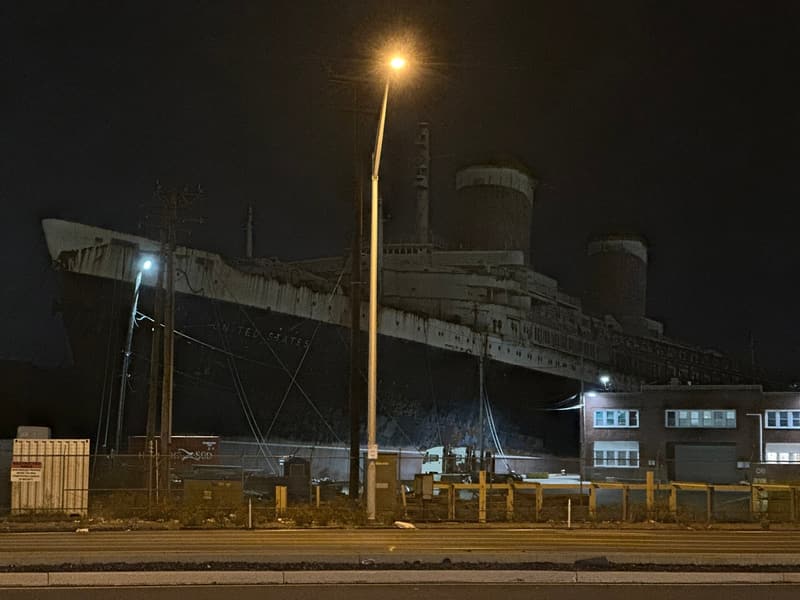
Divers Capture First Footage of SS United States as New Artificial Reef
Representative photo · Photo: Marisauna / Wikimedia Commons, CC BY 4.0
The historic SS United States has been scuttled off the Florida coast, where it now serves as the world's largest artificial reef for marine life.
The legendary SS United States has reached its final destination at the bottom of the Gulf of Mexico, marking a new chapter for the record-breaking ocean liner. Following a deliberate sinking process off the coast of Pensacola, Florida, on November 11, the vessel now rests at a depth of approximately 190 feet. This project has created the world’s largest artificial reef, a site where researchers and diving united states enthusiasts are eager to observe the transformation of the ship into a thriving marine habitat.
On November 13, a team of divers from the RV Explorer successfully documented the ship's condition. Their footage reveals that the vessel is resting upright on the ocean floor, a surprising development given that it initially began its descent on its side. Diver Rustin Cassway described the scene as epic, noting that the ship had been meticulously cleaned prior to the operation. This documentation marks the beginning of a long-term ecological study, with scientists planning annual visits to monitor how the ship’s materials interact with the surrounding marine environment and how various species colonize the structure.
A Legacy of Speed and Innovation
Launched in 1952, the SS United States was a marvel of naval engineering. Designed by William Francis Gibbs, the ship was built to be fast and versatile, with the potential for conversion into a troopship if required by the United States Navy. Although it never served in a military capacity, the liner became a symbol of mid-century travel, carrying immigrants, celebrities, and political figures across the Atlantic. During its maiden voyage, it shattered the transatlantic speed record, crossing from the United Kingdom to New York in just over three days.
Technological advancements were central to the ship's design. It featured a specialized rudder for high-speed maneuverability, state-of-the-art radar equipment, and a unique four-propeller configuration engineered for superior hydrodynamic performance. These innovations ensured the vessel remained the fastest ocean liner of its time. However, as air travel became more accessible and efficient, the demand for ocean liners declined. The SS United States ceased operations in 1969 and spent several decades in drydock before its final transition into an artificial reef.
The SS United States now rests as the world's largest artificial reef off the coast of Florida.
Why it matters
The transformation of the SS United States into an artificial reef represents a significant opportunity for ecological research. By monitoring the ship's decay and the subsequent growth of marine life, scientists hope to gain deeper insights into how large-scale artificial structures influence ocean ecosystems. This project serves as a unique case study for conservationists worldwide, providing a controlled environment to observe the long-term biological impact of such massive submerged vessels.
Sources
More like this

Bluetongue Virus Confirmed in County Down

Jojo the Gorilla Faces Extreme Isolation: Can He Find a Companion?

AI Helps Unlock Discoveries in Kurt Gödel Notebooks