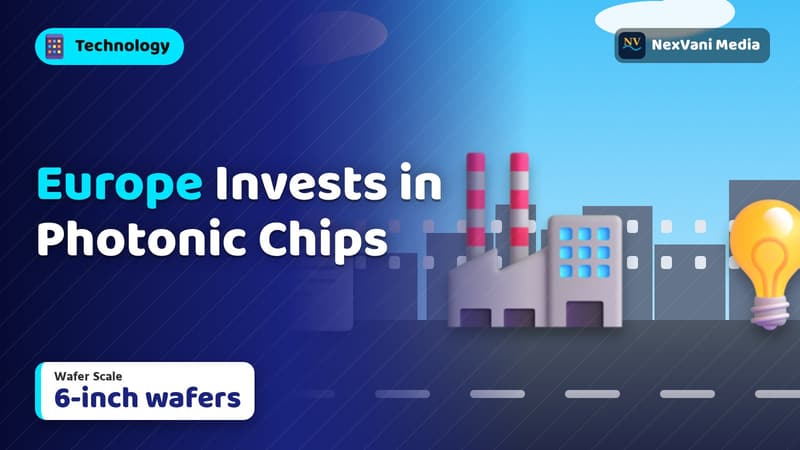
Europe plans leadership in next-generation photonic chips
Illustration: NexVani Media
Europe is investing millions of euros into photonic chips, aiming to become a global leader in a technology that uses light instead of electricity.
As the global demand for advanced computing continues to surge, Europe plans to secure a leading position in the development and manufacturing of next-generation computer chips. Traditional microchips rely on electricity to process data by moving electrons across tiny circuits containing billions of transistors. In contrast, emerging photonic chips utilize light to transmit data, making them significantly faster, more energy-efficient, and capable of generating less heat than conventional semiconductors.
Experts note that while traditional electronics have matured over the past several decades, optical computing remains in its early developmental stages, comparable to where electronic chips stood forty or fifty years ago. Currently, the computer chip sector is heavily dominated by firms based in the United States, Taiwan, and China. To avoid foreign manufacturing dependencies, the European Union has committed four hundred million euros to a strategic initiative known as PIX Europe.
Europe is investing millions to pioneer photonic chips that use light instead of electricity.
Advancing manufacturing capabilities
The overarching goal of the EU initiative is to transition optical chip technology from laboratory settings into full-scale industrial production. Production currently relies on four-inch wafers, but researchers are working to scale manufacturing up to six-inch wafers. A major facility is currently under construction in the Dutch city of Eindhoven to produce six-inch indium phosphide wafers, with operations scheduled to fully launch by 2030.
This regional manufacturing effort benefits from the presence of ASML, a dominant Netherlands-based technology firm that produces specialized lithography equipment required for advanced semiconductor fabrication. Equipment from ASML will form a core component of the new production pilot line in Eindhoven. Industry representatives emphasize that the manufacturing processes for photonic and electronic chips share significant similarities, requiring high-end clean rooms and specialized wafer handling techniques.
Why it matters
This strategic push aims to transform Europe from a research powerhouse into a commercial manufacturing hub for optical semiconductors. By building domestic production infrastructure, the region hopes to reduce its reliance on foreign supply chains and capture a foundational position in a key future technology.
Sources
More like this

Top spy agency suffers network outage in latest US technical failure

California Restricts California Waymo Vehicles on Freeways

Nvidia Spy Scandal Clouds Trump China Visit Ahead of Xi Meeting