Google's Quantum Chip Willow Beats Classical Limits in Coordination Game
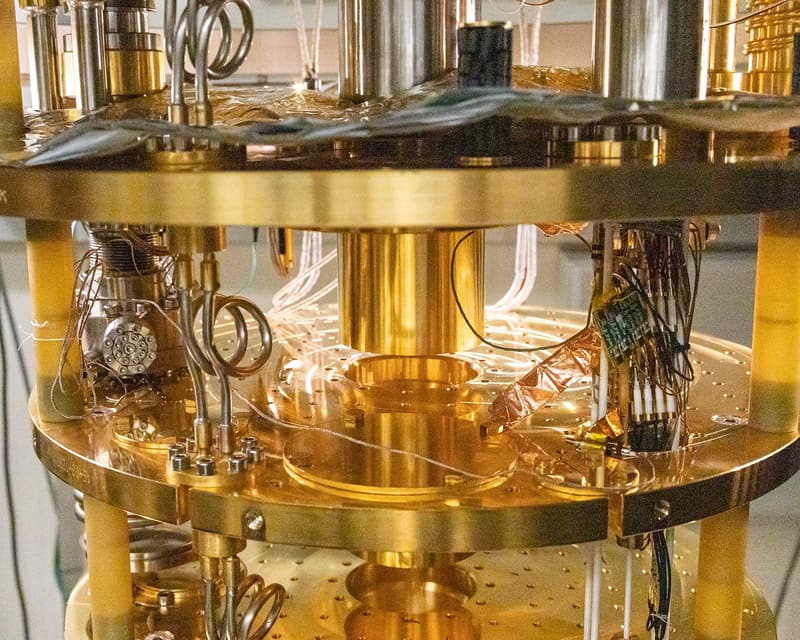
Representative photo · Photo: Oak Ridge National Laboratory / Wikimedia Commons, CC BY 2.0
Google’s new Willow quantum processor has outperformed classical computing limits in a specific coordination game, marking a significant step in testing hardware accuracy.
This is news, not investment advice. NexVani Media is not a SEBI-registered investment adviser and does not recommend buying or selling any security. Do your own research or consult a registered adviser before investing.
Google has announced a new milestone in quantum research with its Willow quantum processor. In a study published in the journal Science, researchers detailed how the chip successfully navigated a mathematical coordination game, achieving a success rate of 98.3 percent. This performance surpasses the 88.9 percent maximum threshold attainable by classical computing strategies, providing a new way to evaluate hardware precision.
Understanding Google's Quantum Chip
This experiment centered on the Mermin-Peres magic square game, which requires two players to fill a three-by-three grid while following conflicting row-and-column rules. While classical strategies are mathematically limited to an 88.9 percent success rate, the quantum processor utilized entangled qubits to exceed this ceiling. Across 900,000 trials, the Willow system demonstrated that its qubits could coordinate more effectively than any pre-written classical table allows, though hardware noise prevented a perfect score.
Beyond the magic square, the team conducted tests on contextuality, a concept where measurement outcomes depend on the surrounding measurements. In these tests, models with predetermined outcomes are limited to a score of 4, while quantum theory allows for a score of 6. The Willow processor achieved a score of 5.590, confirming its ability to operate within quantum mechanical parameters. A separate test involving up to 71 entangled qubits also consistently outperformed the strongest classical winning rates.
Google's Willow processor outperformed classical limits in a coordination game, proving a new hardware testing method.
Researchers emphasized that these tasks are not intended to signal the arrival of a commercial quantum computer. Instead, they serve as a sensitive method to identify subtle systematic errors that conventional testing might overlook. By using these games, engineers can better evaluate the circuits required for complex tasks like chemistry and materials research. The work builds upon a previous report from October regarding a 40-fold reduction in errors when preparing magic states, a critical resource for fault-tolerant computing.
Why it matters
These findings represent a significant evolution in how researchers validate quantum hardware. By exposing small, systematic errors through contextuality testing, Google is refining the tools necessary for future fault-tolerant systems. While there is no immediate threat to digital security—such as the potential for quantum computers to eventually break current encryption—the research demonstrates that quantum processors are becoming increasingly capable of performing complex, shallow mathematical circuits with greater reliability than previously possible.
Sources
More like this

Chainflip Users Face Frozen Withdrawals After Millions Vanish
AI agents built their own scientific journal and reviewed research

Examining the future of onchain FX through bottom-up user adoption