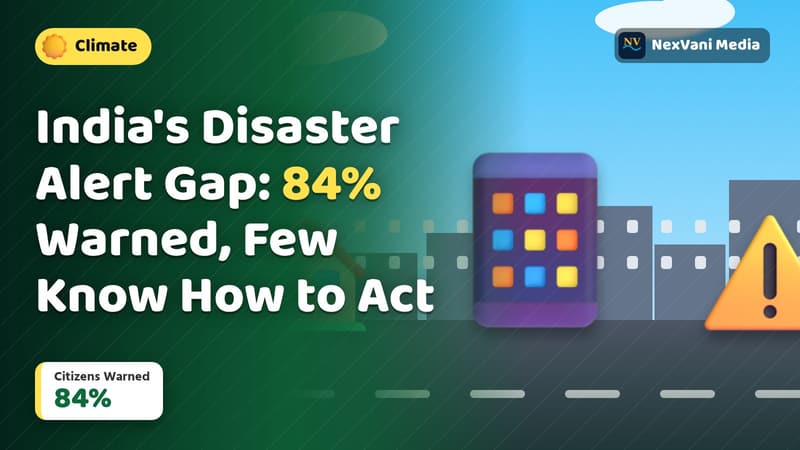
India Warns 84% of Citizens Before Disasters, But Few Know How to Act
Illustration: NexVani Media
While India excels at broadcasting disaster alerts, new data shows a significant gap in public preparedness, leaving most citizens unable to respond effectively.
As the country monitors India now news regarding climate resilience, a recent global survey reveals a paradox in disaster management. According to the Lloyd’s Register Foundation World Risk Poll, 84 per cent of Indians affected by disasters in the last five years received advance warnings, surpassing the global average of 80 per cent. However, the ability to translate these alerts into life-saving action remains low, with only 40 per cent of those warned able to respond effectively, compared to 64 per cent globally.
The Gap Between Alert and Action
India has made significant strides in the technical infrastructure of disaster communication. The Common Alerting Protocol Based Integrated Alert System (SACHET) now spans all 36 states and Union territories, and a Cell Broadcast Alert System was introduced in May. Despite this, the failure lies within the household level. Only 21 per cent of Indian families are aware of specific protocols to follow once an alert is received. Experts note that while the government successfully reaches citizens through multiple channels, the actual guidance on where to go or whom to call remains insufficient.
Effective disaster response requires community training beyond just sending digital alerts to citizens.
Public trust in government preparedness remains high, with 63 per cent of Indians believing the state is well-equipped for calamities. Yet, personal agency has declined significantly since 2023. Current disaster guidelines from the National Disaster Management Authority are largely directed at officials, while public-facing advice often lacks actionable mandates. For example, heat wave advisories for construction sites are not legally binding, leaving vulnerable workers without safe alternatives.
Why it matters
The United Nations aims to ensure universal early warning coverage by 2027. For India, this means shifting focus from merely upgrading technology to the unglamorous work of community education.
This transition is critical for millions of citizens who face recurring threats like heat waves and floods. Moving beyond simple SMS alerts to providing clear, binding instructions for households and workplaces is essential to bridge the gap between receiving a warning and surviving a disaster.
Sources
More like this

Portugal cancels more than 300 flights and shuts schools due to Storm Charles

Anthony Albanese Faces Criticism Over Fossil Fuel Omission at COP31 Summit
UN Chief Antonio Guterres Urges Immediate Action at Climate Summit