
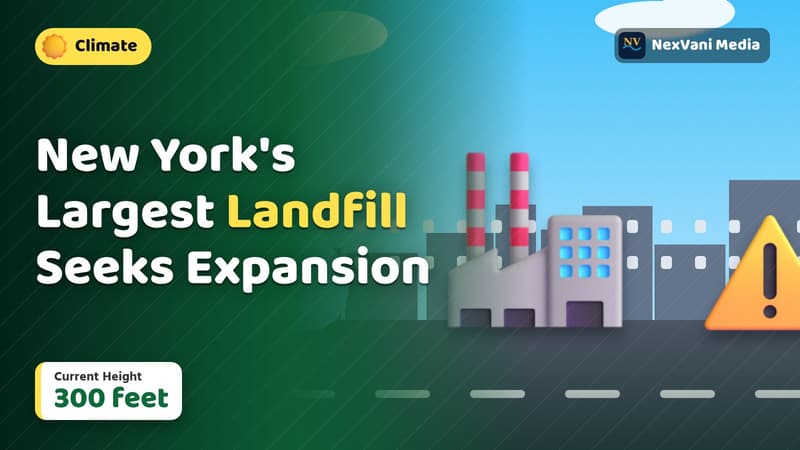
Seneca Meadows landfill expansion highlights New York waste crisis
Illustration: NexVani Media
New York's largest landfill, as tall as the Statue of Liberty, is seeking to expand, sparking intense debate over waste management and environmental impact.
The Seneca Meadows landfill in New York’s Finger Lakes region has become a stark symbol of the state's growing waste management crisis. Rising to roughly 300 feet, the facility stands at a height comparable to the New York Statue of Liberty, casting a long shadow over the surrounding landscape. As the site nears its capacity, operators are seeking approval to expand the landfill further, a move that has drawn significant opposition from local residents and environmental advocates.
Since the 1980s, the landfill has grown to cover 350 acres. While local communities in Waterloo and Seneca Falls had hoped for the site’s closure upon the expiration of its permit last year, the Texas-based operator, Waste Connections, has proposed adding 70 feet to the height of the trash heap and developing 47 acres of new disposal cells. This expansion would extend the life of the dump for several more decades.
The expansion of New York's largest landfill highlights a growing crisis in waste management and environmental health.
The environmental cost of waste
The facility is now a primary source of methane in New York, a potent greenhouse gas that contributes to climate change. Beyond air quality concerns, residents report issues with pungent odors and potential groundwater contamination. Assembly member Emily Gallagher, who has toured the site, described the mountain of trash as an ongoing crisis, noting that much of the material deposited could be recycled. She argues that the state needs a fundamental shift in its convenience culture to address the volume of waste being produced.
Waste Connections has defended its operations, citing an exemplary compliance record and the use of double composite liners and gas collection systems to mitigate environmental harm. However, the company did not respond to recent inquiries regarding the expansion plans. Meanwhile, New York City, which sends a portion of its 12,000 tons of daily trash to landfills across the state, continues to seek long-term solutions as regional capacity shrinks.
Why it matters
The ongoing struggle at Seneca Meadows reflects a broader challenge regarding how society handles the byproduct of modern consumption. For local communities, the expansion threatens quality of life through persistent odors and potential environmental degradation.
This issue forces a confrontation with the limits of current disposal methods. As landfills reach capacity and the search for new sites becomes increasingly difficult, the reliance on exporting waste to distant locations is becoming a standard, albeit temporary, solution for major urban centers.
Sources
More like this
Delhi AQI Settles at 349 as Air Quality Shows Marginal Improvement

Understanding what's El Niño mean for North American weather

Winter Bengaluru: City Records Season’s Sharp Temperature Dip
