Major Bitcoin Miners Pivot to AI Infrastructure as Mining Profits Decline
Illustration: NexVani Media
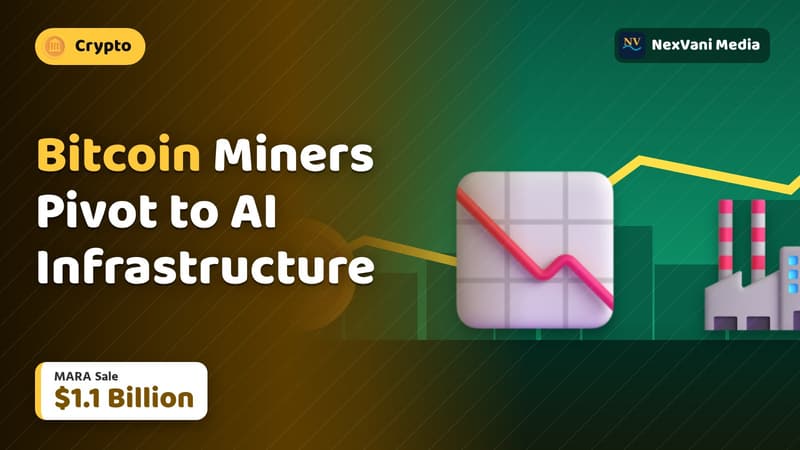
Leading U.S. Bitcoin miners MARA and Riot Platforms are selling significant portions of their crypto reserves to finance expansion into AI data centers and cover operational debt.
This is news, not investment advice. NexVani Media is not a SEBI-registered investment adviser and does not recommend buying or selling any security. Do your own research or consult a registered adviser before investing.
Two of the most prominent U.S. bitcoin miners are reallocating their digital assets to fund a transition toward artificial intelligence infrastructure. This strategic shift comes as mining economics face increased pressure, prompting firms like MARA and Riot Platforms to liquidate substantial portions of their holdings to finance data center development and debt repayment.
According to its third-quarter filing with the SEC, MARA sold 13,597 BTC after the end of September at an average price of approximately $81,039, generating roughly $1.1 billion. This sale represented about 40% of the 34,012 BTC the company held at the end of September. When combined with the 26,984 BTC sold during the first nine months of the year, MARA has offloaded over 40,000 BTC in 2026, a total valued at roughly $2.5 billion at current market prices. The company utilized $750 million of these proceeds to settle Bitcoin-backed loans originally taken to acquire the Long Ridge power plant. Despite these moves, MARA stated that mining remains its operating foundation and that this shift is not a total departure from the asset class.
The Shift in Bitcoin Miners Strategy
Riot Platforms has followed a similar path. According to its November 4 results, the company sold 20,264 BTC in the first nine months of the year for about $1.5 billion, primarily to fund data center expansion. By the end of September, its holdings had decreased to 2,418 BTC. Riot also entered into a significant 15-year lease for its Corsicana, Texas, campus, which covers 910 megawatts of capacity. The company identified the tenant for this facility as Anthropic, with CEO Jason Les describing the agreement as the largest lease in the firm's history.
Financial data highlights the motivation behind these sales. Riot reported that its mining revenue fell to $116 million in the third quarter, down from $160.8 million a year earlier, as the average value of each mined coin dropped. Furthermore, the company noted that including equipment depreciation, it cost $78,805 to mine each Bitcoin, exceeding the coin's average value during the quarter. MARA also saw its revenue decline by 35% to $164.2 million.
Bitcoin miners are liquidating large portions of their holdings to finance AI infrastructure and debt repayment.
These sales have added supply to the market, which onchain analytics firm Glassnode identified as a primary driver of recent selling by treasury companies. However, the firm noted that other treasury holders remained net buyers throughout November. Notably, MicroStrategy continued to expand its position, adding 485 BTC last week to reach a total of 850,849 BTC.
Why it matters
The move by major miners to prioritize AI infrastructure over pure Bitcoin accumulation marks a significant shift in the industry's business model. By pivoting toward high-performance computing, these companies are attempting to diversify revenue streams in response to narrowing mining margins.
For investors and observers, this trend highlights the growing intersection between crypto-mining operations and the AI boom. While these sales have created short-term supply pressure in the Bitcoin market, they also reflect a long-term capital reallocation by firms seeking to capitalize on the rising demand for data center capacity.
Sources
More like this

Binance Secures Court Order to Recover Funds After $6.3 Billion Hack
MARA Holdings Prices $185M Debt Offering Following $1.1B Bitcoin Sale
Fed's Christopher Waller Advocates for 50-Basis-Point Rate Hike in December