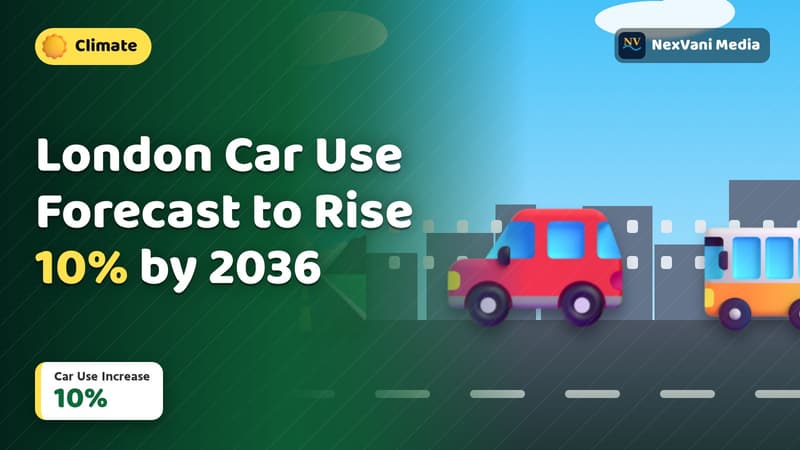
Official Forecast Predicts 10% Rise in Car Use in London Over Next Decade
Illustration: NexVani Media
A draft 10-year London plan suggests motor vehicle trips could rise by 10%, challenging the mayor's environmental goals and raising concerns over future traffic congestion.
Projections within a draft 10-year London plan suggest that the reliance on a car in London is set to increase by 10% over the coming decade. This forecast, developed by the mayor’s office and Transport for London (TfL), indicates that as the city's population grows, the proportion of trips made via walking and cycling may decline, potentially complicating Sadiq Khan’s environmental pledges.
Official forecasts suggest a 10% rise in London car use, threatening air quality and congestion targets.
Future of the Car in London
The draft plan for 2026-36 models three scenarios for population and job growth. The central projection anticipates the population rising from 9.1 million to 9.9 million. Under this scenario, motor vehicle trips are expected to increase by 10% between 2023 and 2036. While public transport usage is also projected to rise by 17%, active travel—such as walking and cycling—is expected to grow by only 6%, resulting in a slight decrease in its overall share of city journeys.
Mayoral officials have disputed the inevitability of these figures, describing them as modelling based on an assumption that no new transport policies are implemented. They argue that the projections do not account for recent initiatives like the pedestrianisation of Oxford Street or the expansion of school streets. A spokesperson for the mayor stated that City Hall expects active travel to increase significantly by 2036, noting that the current modelling helps identify where future interventions are required.
Critics, however, remain concerned. Ralph Smyth of the Transport Action Network argued that progress in shifting the capital away from car use has stalled. He suggested that the plan fails to leverage the opportunity to create a cleaner, less congested city. Additionally, campaigners like Jenny Bates from Friends of the Earth pointed out that while the transition to electric vehicles is beneficial, it will not resolve the issue of road congestion.
Infrastructure Challenges
The report warns that increased motor traffic could lead to a 7% reduction in average road speeds, which would further slow down bus services. Furthermore, the underground network faces the prospect of severe overcrowding. The modelling indicates that peak demand may necessitate regular interventions, such as closing stations to entering passengers or having trains pass through stations without stopping.
Why it matters
This forecast highlights a significant tension between projected population growth and the infrastructure required to maintain air quality and mobility. The potential increase in traffic threatens to undermine climate goals, including the mayor’s 2022 pledge to reduce car use by 27% by 2030.
For residents and commuters, these findings signal a risk of worsening congestion and public transport strain. While the impact is localized to the UK capital, the debate reflects a broader global struggle in urban planning: balancing the needs of a growing population with the urgent requirement to reduce reliance on private vehicles to meet environmental standards.
Sources
More like this

Developer accused of environmental vandalism over hedgerow clearance
Leftover pumpkins help deliver 1,000th free meal in Cambridge

IEA Report Warns Carbon Emissions from Data Centres to Rise 70% by 2030