Dubai Property Market Enters New Phase of Maturity in 2026
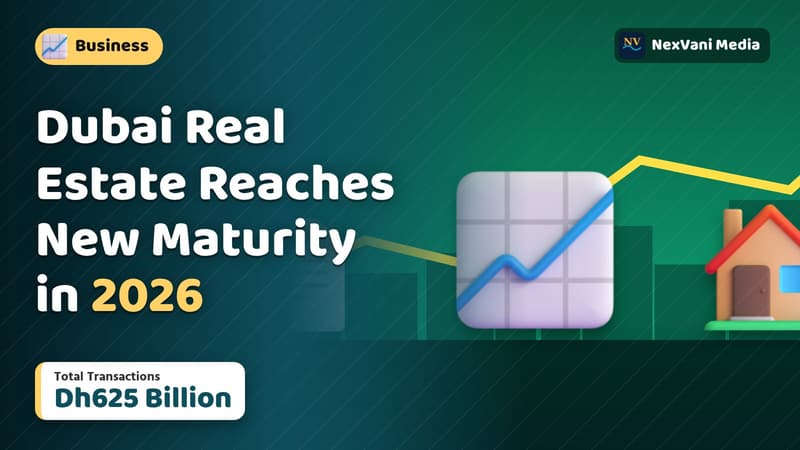
Illustration: NexVani Media
Dubai's real estate sector is transitioning toward sustainable growth, with experts highlighting selective investment opportunities as the market enters a period of consolidation.
As the year 2026 draws to a close, the Dubai property market is entering a phase of increased maturity and stability. Following the exceptional growth observed throughout 2025, market fundamentals are now pointing toward a more balanced environment, characterized by selective investment opportunities. Data through the end of October indicates that the sector has successfully absorbed natural market cycles while maintaining its appeal to both local and international investors.
Mohamed Al Mutawa, Chairman of Al Waleed Real Estate, noted that the market is demonstrating greater awareness as it adjusts to new supply. Total real estate transactions in the emirate reached nearly Dh625 billion during the first ten months of 2026, encompassing over 181,000 individual deals. This volume remains among the highest in the history of the Dubai property market. October specifically saw a rebound, with sales values rising 18% month-on-month to Dh34.8 billion, breaking a two-month trend of decline.
Dubai real estate is shifting toward sustainable growth as investors prioritize quality and long-term value.
Evolution of the Dubai Property Market
While 2025 was marked by rapid expansion, including apartment sales exceeding Dh183 billion, Al Mutawa emphasized that such periods are typically followed by necessary consolidation. This transition should not be interpreted as a slowdown, but rather as an evolution toward sustainable growth. Investors are increasingly focusing on project quality, location, and long-term utility, which are becoming the primary drivers of decision-making.
Looking ahead to 2027, Al Mutawa anticipates that investment interest will concentrate on specific segments. Commercial assets, particularly office and retail spaces, are expected to remain in demand due to limited supply and rising rental yields. Furthermore, emerging areas such as Dubai South, buoyed by the expansion of Al Maktoum International Airport, and locations benefiting from future Dubai Metro extensions, are likely to see sustained interest.
As residential supply is projected to increase in 2027 and 2028, the market will likely see greater differentiation. Developments that offer superior quality and attractive lifestyle features are expected to maintain their competitive edge, while less prominent projects may face increased pressure on pricing and rentals.
Why it matters
The transition toward a more selective investment landscape signifies a shift in how stakeholders approach the Dubai real estate market. For investors, this environment prioritizes long-term capital appreciation and quality-driven assets over rapid, speculative gains.
This maturation process is supported by the emirate’s robust infrastructure and investor-friendly regulations. As the market rebalances, it continues to offer stability for global investors, including those from South Asia, who remain key participants in the emirate's ongoing economic development.
Sources
More like this

Gloucester Cathedral Restructures Operations to Manage Financial Pressures
Inflation rises in the UK as energy and food costs shift
SSE Threatens Closure of Yorkshire Gas Storage Site Unless Ministers Intervene