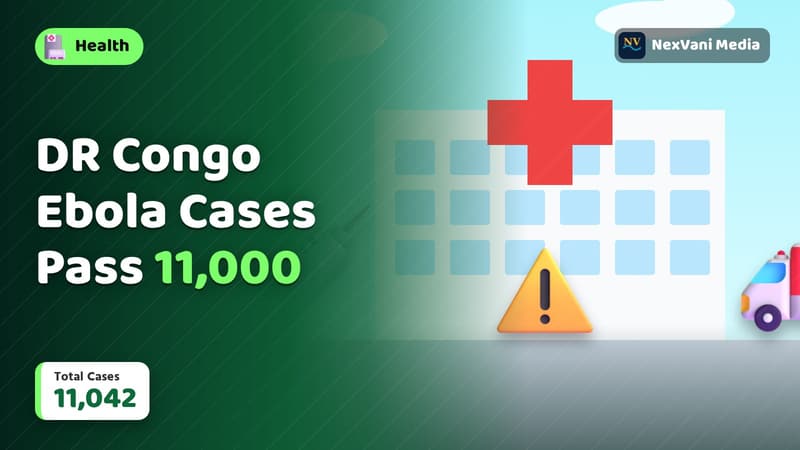
Ebola cases in DR Congo pass 11,000, with 5,387 deaths
Illustration: NexVani Media
The Democratic Republic of the Congo faces its deadliest Ebola outbreak, with over 11,000 confirmed cases and 5,387 deaths reported by government officials.
Health authorities in the Democratic Republic of the Congo (DRC) have confirmed that the nation is grappling with a severe health crisis as the total number of Ebola cases in the country has reached 11,042. According to official government data released on Tuesday, the death toll from the ongoing epidemic has climbed to at least 5,387. This event, often searched as an ebola congo outbreak, represents the most significant and lethal viral surge in the nation's history.
Understanding the ebola congo outbreak
The current crisis is driven by the rare Bundibugyo strain of the Ebola virus, which has a mortality rate of approximately 50 percent. Unlike previous health emergencies, this outbreak has demonstrated a remarkably wide geographic reach, impacting eight of the DRC’s 26 provinces. Furthermore, reports indicate that the virus has now spread across East, Central, and West Africa, marking the most extensive geographic distribution of any Ebola outbreak documented on the continent to date.
The DRC is battling its largest and deadliest Ebola outbreak with over 11,000 confirmed cases recorded.
Containment efforts have been hindered by a combination of factors, including delayed detection of the virus, ongoing regional conflict, and significantly strained healthcare infrastructure. Because no specific vaccine or treatment exists for the Bundibugyo strain, medical teams are facing immense challenges in halting the transmission. Many fatalities have occurred outside of designated treatment centers, complicating efforts to track and isolate the virus effectively.
In response to the escalating situation, the World Health Organization recently approved clinical trials for two potential new vaccines. While these trials offer a glimmer of hope for future mitigation, officials noted that results are not expected until early 2027. This epidemic is now officially the second-largest and second-deadliest on record, trailing only the 2014-2016 West African outbreak, which resulted in over 28,600 infections and 11,000 deaths.
Why it matters
The rapid spread of the virus underscores the fragility of health systems in conflict-affected regions. The inability to deploy specific treatments for the Bundibugyo strain has left local populations vulnerable, and the wide geographic expansion of the virus poses a significant challenge to international public health monitoring.
For the global community, including regions like South Asia, the situation serves as a reminder of the risks posed by emerging infectious diseases. The lack of ready-to-use vaccines for this specific strain highlights the critical need for continued investment in medical research and international cooperation to prevent future regional outbreaks from becoming continental crises.
Sources
More like this
Disabled people in England face two-year waits for essential wheelchairs

FDA mandates new warning labels for GLP-1 drugs over rare eye condition

Makers of GLP-1 drugs ordered to add warnings about rare eye condition