Kraken Parent Payward Gains Market Share as Slower Trading Weighs on Earnings
Illustration: NexVani Media
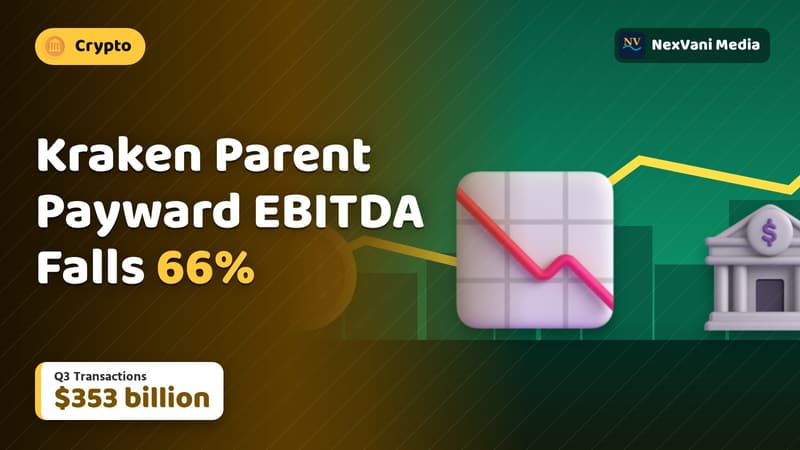
Payward, the parent company of Kraken, saw its adjusted EBITDA drop by 66% year-over-year to $60 million as lower transaction volumes impacted overall financial performance.
This is news, not investment advice. NexVani Media is not a SEBI-registered investment adviser and does not recommend buying or selling any security. Do your own research or consult a registered adviser before investing.
Payward, the parent company of the cryptocurrency exchange Kraken, has reported a significant shift in its business performance as it navigates a changing market landscape. While the company successfully grew its share of global crypto spot trading to 6.5% in September, up from 3.3% a year earlier, overall earnings faced downward pressure due to weaker trading activity. This development regarding Kraken Payward news highlights the company's ongoing efforts to diversify its revenue streams beyond traditional transaction fees.
Payward's adjusted EBITDA fell 66% year over year to $60 million despite gaining significant global market share.
According to the financial results released on Friday, Payward handled $353 billion in transactions during the third quarter, representing a 30% decline from the previous year. The company noted that its market share gain reflects a larger portion of spot trading relative to competitors rather than an increase in total platform activity. Adjusted EBITDA for the quarter reached $60 million, down from $178.6 million in the same period last year. Total platform margin also saw a 12% decrease, settling at $487 million.
Diversifying Beyond Trading
Over the past two years, Payward has aggressively expanded its operations through strategic acquisitions. These include the futures broker NinjaTrader, proprietary trading firm Breakout, and the US-regulated derivatives platform Bitnomial. Additionally, the company entered the stablecoin payments sector with the purchase of Reap in July. These moves are designed to reduce reliance on transaction fees, which are inherently volatile and linked to market conditions.
These initiatives are beginning to show results. The number of derivatives contracts processed by the firm rose 84% to 66 million, while revenue from subscriptions, trader evaluations, and other paid services increased 59% to $125 million. Furthermore, margin earned from assets held on the platform, including staking services, grew 26% to $128 million. Collectively, asset- and access-based services now account for 52% of total platform margin, a notable increase from 46% a year ago.
Future Outlook and IPO Plans
While current results remain below year-earlier levels, there has been a sequential improvement compared to the second quarter. Total transaction volume rose 22%, and total platform margin increased by 12%. Payward, which had previously filed confidentially for a US IPO in November 2025, paused those plans in March due to market conditions. The company is currently considering a potential listing window in the second quarter of 2027.
Why it matters
The financial shift at Payward underscores the broader industry trend of crypto exchanges moving away from a pure-play trading model toward diversified financial services. By prioritizing subscription-based income and asset-holding margins, the company aims to stabilize its profitability against the cyclical nature of crypto trading volumes.
For investors and market observers, this transition is critical as it influences the valuation and operational profile of the firm ahead of its potential future public listing. The company's ability to maintain these service-based margins will likely be a key factor for its long-term growth strategy.
Sources
More like this

US Regulators Advance Crypto Trust Charters Amid Growing Senate Scrutiny

China AI Pipeline Relies on Nvidia Despite Restrictions

Bill Miller Investor Discusses Why He Remains Bullish On Bitcoin