BepiColombo Spacecraft Nears Mercury After Eight-Year Journey
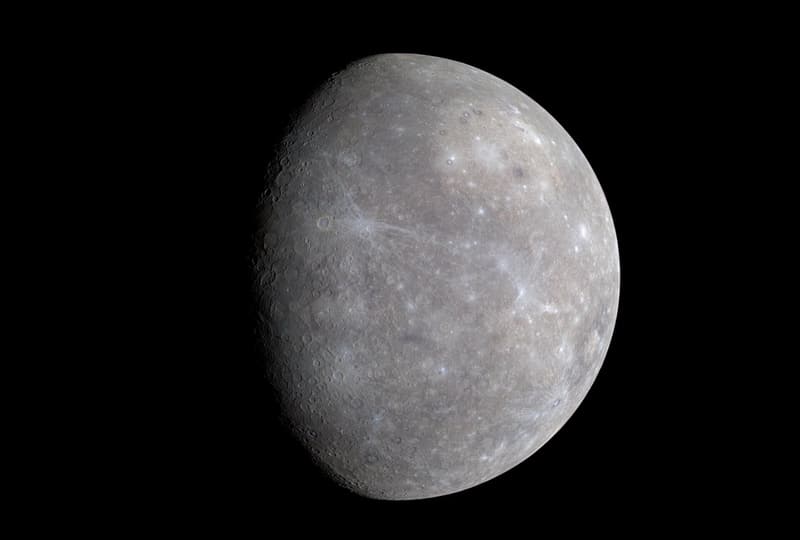
Representative photo · Photo: NASA / Johns Hopkins University Applied / Wikimedia Commons, Public domain
After an eight-year voyage, the BepiColombo spacecraft is preparing to enter orbit around Mercury to solve long-standing mysteries about the planet.
The BepiColombo spacecraft is approaching its final destination, poised to enter orbit around Mercury after an epic eight-year journey covering nearly six billion miles. This mission aims to explore the mysterious Mercury, a planet that has remained largely enigmatic despite its proximity to the Sun. Launched from French Guiana in 2018, the spacecraft has navigated a complex path, utilizing gravity assists from Earth and Venus to manage the Sun's immense gravitational pull. Although the mission was originally planned for a seven-year duration, propulsion system challenges extended the transit by an additional year.
Navigating a Hostile Environment
Mercury presents an incredibly harsh environment for any visitor. Temperatures on the surface fluctuate between a scorching 430C and a freezing -180C, while the planet is subjected to constant, intense solar radiation. To successfully begin its mission, BepiColombo must perform a critical 11-minute maneuver to be captured by the planet's gravity. Failure to execute this precise turn could result in the spacecraft missing its target entirely. This mission is unique as it carries two separate spacecraft onboard to conduct its research.
The BepiColombo mission will provide unprecedented insights into Mercury's formation, evolution, and extreme space environment.
Uncovering Planetary Secrets
Scientists hope to address several puzzling features of Mercury, including the presence of ice within craters despite the planet's extreme heat. Researchers are also eager to investigate thousands of shallow, steep-sided hollows scattered across the surface. These features are relatively young in geological terms, dating back approximately 100,000 years, yet their exact origins remain unknown. Furthermore, the mission will examine why Mercury possesses a disproportionately large metal core. Prof Emma Bunce of Leicester University suggests this may be the result of a massive ancient collision that stripped away the planet's outer mantle, or perhaps a consequence of its formation in a metal-rich region of the early Solar System.
Why it matters
This mission is significant because it provides the most comprehensive opportunity to study the innermost planet of our Solar System. By understanding how Mercury formed and how it interacts with the Sun, scientists can gain broader insights into the evolution of planetary bodies.
This research is vital for planetary science, as previous exploration has been limited to only two NASA missions: Mariner-10 in the 1970s and the Messenger spacecraft, which concluded its four-year orbital study in 2015.
Sources
More like this

SpaceX Starship Progress and the Legacy of Extraterrestrial Messaging

Spuds in space: scientists say potatoes could power moon bases

US Army Prepares Controlled Detonation of Unstable Chemicals at Iowa Plant