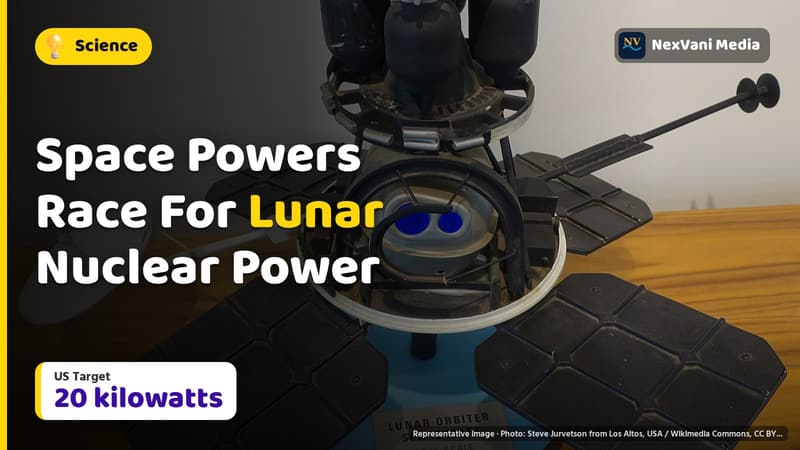
Why are US, Russia and China racing to put nuclear reactors on the moon?
Representative image · Photo: Steve Jurvetson from Los Altos, USA / Wikimedia Commons, CC BY 2.0
Major space powers are competing to install nuclear power sources on the lunar surface to sustain future bases and mining operations, raising contamination concerns.
Global space agencies are locked in a high-stakes competition to deploy nuclear fission generators on the lunar surface, prompting warnings from researchers regarding potential radioactive hazards. In January, American space officials disclosed timelines to establish a lunar generator by the conclusion of 2030. Meanwhile, Moscow and Beijing intend to deploy a comparable system by 2036 as part of broader extraterrestrial ambitions.
Power units are essential for extracting frozen water hidden inside permanently shadowed polar craters, which researchers believe could supply breathing air, hydration, and propellant. While exploring why russia not in world cup remains a separate sporting query, governments are focusing heavily on lunar logistics. The American system, designated Lunar Reactor 1, is engineered to generate 20 kilowatts of electricity autonomously for half a decade without requiring servicing. Weighing under six thousand kilograms, it is built to fit inside compact rocket compartments.
Selena Reactor Specifications
Russia is developing a lighter alternative called Selena, designed to produce 10 kilowatts and function for ten years without intervention. Weighing between eleven hundred and thirteen hundred kilograms, Selena is intended for softer touchdowns to support a Chinese-led station by the mid-2030s. Both Washington and Moscow plan to keep their respective generators powered down during transit to mitigate radiological dangers until final deployment.
Space powers race to deploy lunar nuclear generators to power future bases and water-ice mining.
Placing nuclear technology in space is not unprecedented. During the Cold War, the Soviet Union deployed over thirty fission units into Earth orbit to energize radar tracking equipment. Conversely, American efforts have faced historical delays, though recent executive directives and international competition have renewed urgency for lunar infrastructure.
Why it matters
Establishing reliable energy sources on the moon will transform how space agencies sustain long-term exploration and resource extraction. Because solar panels experience darkness for half of every month and alternative energy options like diesel are prohibitively heavy to transport from Earth, nuclear power has emerged as a crucial necessity. However, scientists caution that these operations must handle radioactive materials responsibly to avoid contamination risks.
Sources
More like this

Largest Woodland Bat Survey Highlights Success of Artificial Intelligence
BBC Inside Science Explores Biodiversity Goals and Climate History
Turkiye President Recep Tayyip Erdogan Urges End to Black Sea Attacks