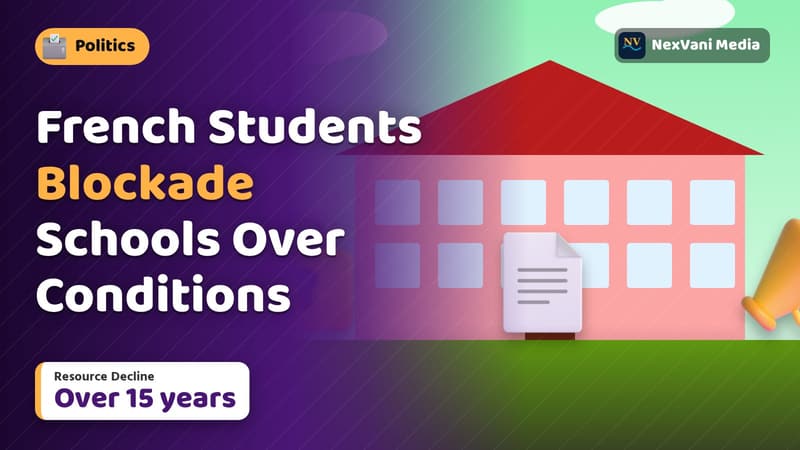
At the Origin of France’s Education Protests, Students Refuse to Give Up
Illustration: NexVani Media
Students and teachers in French suburbs continue to blockade schools, demanding better conditions and protesting against perceived government neglect.
In the suburbs of Paris, the origin of France’s education protests remains a flashpoint as students and teachers continue to hold blockades at school gates. What began in mid-September at a high school in Creteil has rapidly expanded into a nationwide movement, with young people in Saint-Denis and beyond refusing to return to classrooms until their demands for improved infrastructure and resources are addressed.
At the Paul Eluard high school in Saint-Denis, students and staff gathered outside locked gates in early November. Some students wore costumes to maintain morale, emphasizing that their movement is driven by a desire for change rather than violence. For many, the protests represent a fight for respect and a future that they feel the current national leadership has ignored.
Students continue to blockade schools across France to protest deteriorating educational conditions and lack of resources.
Demands for Change
Students have reported dire conditions within their schools, including dirty facilities, pest infestations, and insufficient access to water. Teachers have joined the movement in solidarity, noting that educational resources have steadily declined over the past 15 years despite rising student numbers. Lucie Sabze, an English teacher, praised the students for their lucid political discourse and clear demands.
While the government, led by President Emmanuel Macron, has acknowledged the anxieties of the youth, students argue that no concrete solutions have been provided. Critics, including National Assembly member Louis Boyard, argue that austerity policies have dismantled public education in favor of the private sector, leaving many young people feeling abandoned.
A Local Victory
Amid the broader struggle, teachers at Paul Eluard celebrated the resignation of their head teacher. The principal had faced intense backlash for allowing a member of a motorized antiterrorism brigade to enter the school to arrest a student. A government agency confirmed his departure, citing it as a safety precaution following public accusations.
Why it matters
The ongoing protests highlight a deep-seated frustration with the quality of public education and resource allocation in France. By refusing to back down, students are forcing a national conversation about the state of public services and the government's commitment to its youth.
This movement underscores the tension between austerity-driven policies and the needs of working-class communities. For observers globally, the situation serves as a case study in how grassroots student activism can challenge national policy and demand institutional accountability.
Sources
More like this
Rep. Thomas Massie Pushes for New Legislation to Support Epstein Survivors
Democratic Leadership Battle: How Senate Majority Leader Is Chosen

Government Must Act on Government Royal Mail Challenges, Says Former Minister