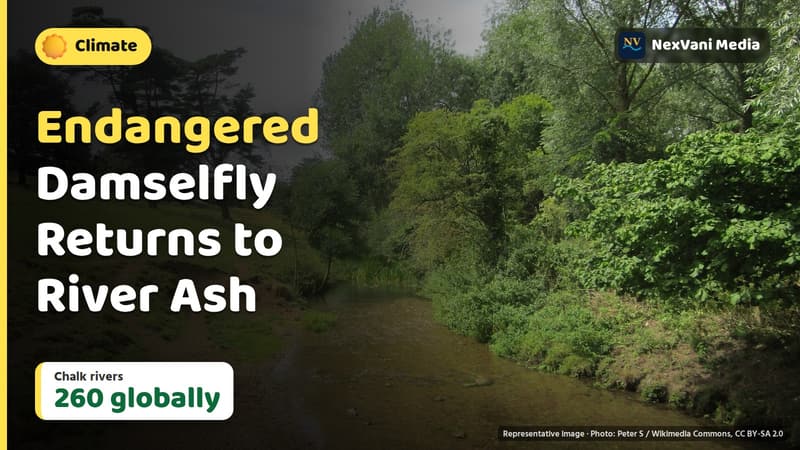
Endangered rare damselfly spotted at restored River Ash site
Representative image · Photo: Peter S / Wikimedia Commons, CC BY-SA 2.0
An endangered scarce blue-tailed damselfly has been discovered in newly created wetlands following a major restoration project on the River Ash.
Conservationists have reported the sighting of an endangered scarce blue-tailed damselfly along a section of the River Ash near Hertford. This discovery follows an extensive project that restored a 4.3-mile stretch of the waterway, which is one of approximately 260 chalk rivers globally, to its original course. The insect, recognized as one of the world's earliest flying species, was recorded at two monitoring sites within the Easneye Estate during late summer.
The importance of a rare damselfly
The presence of this rare damselfly serves as a significant indicator of the success of recent environmental interventions. The restoration project involved creating new gravel beds and reconnecting floodplains to improve the river's health. Monitoring data collected before and after the works indicate a positive trend in biodiversity, specifically noting an increase in river invertebrates such as mayflies and stoneflies.
Restoring chalk river habitats has successfully provided a home for the endangered scarce blue-tailed damselfly.
This development comes at a critical time for insect conservation in Britain. A recent assessment by the British Dragonfly Society, which reviewed the status of various species, reclassified the scarce blue-tailed damselfly from Near Threatened to Endangered. The study highlights a broader trend of decline, revealing that the number of endangered dragonfly and damselfly species in Britain has doubled since 2008, rising to eight in total.
Rivers recovery manager Sarah Perry noted that natural, connected floodplains and healthy wetlands are essential for supporting biodiversity. These environments provide vital spaces for wildlife to feed and breed while simultaneously assisting in water management, which enhances resilience against both flooding and drought. The sightings on the River Ash are viewed as a hopeful example of how targeted habitat restoration can yield tangible benefits for species under environmental pressure.
Why it matters
The Herts and Middlesex Wildlife Trust emphasizes that creating and restoring suitable habitats is vital to reversing the decline of species facing increasing environmental pressure. By improving the ecological health of rare chalk rivers, conservationists are demonstrating that targeted restoration can provide a lifeline for endangered insects.
This project highlights a broader global need for habitat connectivity. While the specific restoration occurred in the United Kingdom, the principles of maintaining healthy wetlands to support biodiversity and water management are universal, offering a model for conservation efforts in regions worldwide that rely on river health for environmental stability.
Sources
More like this

Environmental Campaigners Stage Halloween Protest Outside bute house edinburgh

Chancellor Healey to Veto Offshore Wind Projects Not Lowering Bills

Black Sea Marine Life Faces Devastation Amid Conflict And Deaths Russia Ukraine War