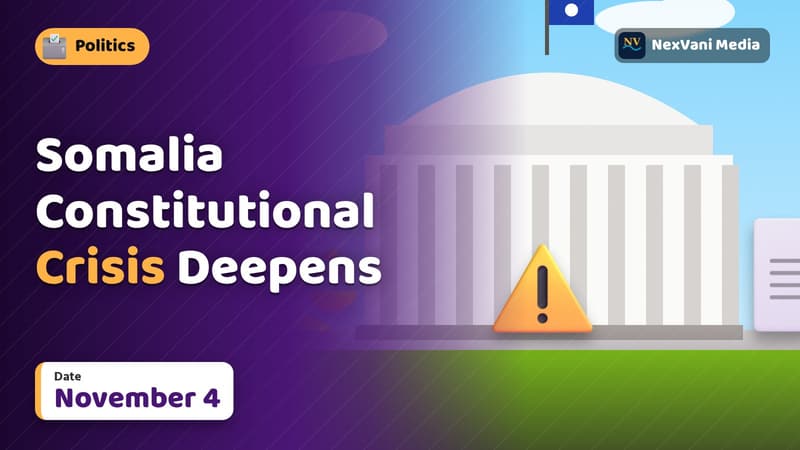
Somalia Constitutional Crisis Deepens Over President Term
Illustration: NexVani Media
A high-stakes political standoff unfolds in Mogadishu as President Mohamud and the top court clash over disputed constitutional amendments.
A political standoff is gripping Mogadishu after President Hassan Sheikh Mohamud removed the chief justice just before a ruling on his term extension. The presidency dismissed Chief Justice Bashe Yusuf Ahmed on November 4, pointing to administrative grievances. The following day, five remaining judges moved forward with the case, determining that constitutional amendments lengthening presidential and parliamentary terms from four to five years cannot apply retrospectively to current officeholders, whose mandates have officially expired. The administration promptly rejected this verdict and swore in a new chief justice, creating a direct collision between the executive branch and the highest judiciary over the expiration of the presidential mandate and election timelines.
This confrontation represents the pinnacle of a two-year political battle surrounding the administration's proposed changes to the legal framework. While proponents argue that enhanced national institutions and direct elections are essential for national reconstruction, critics and regional leaders view the unilateral rewriting of the rules as a threat to the foundational federal agreement of 2012. The dispute has already moved beyond political negotiations, leading to cooperation suspensions by two federal states and localized security clashes.
Somalia Constitutional Crisis
Historically, the collapse of the central government in 1991 led to the emergence of regional administrations built around clan alliances, eventually forming the basis of the modern federal system. The provisional constitution established in 2012 created a power-sharing framework between Mogadishu and the regions, though many critical questions regarding resource control and authority division were deferred. Experts note that the current administration seeks to centralize authority over domains traditionally managed by regional states, such as Puntland and Jubaland. These regional administrations argue that changing the foundational federal bargain through a parliamentary majority violates the original consensus.
Tensions have been further inflamed by geopolitical frictions, including disagreements over foreign partnerships and port agreements involving the United Arab Emirates. With international recognition of Somaliland adding another layer of complexity, regional leaders warn that the ongoing deadlock threatens the future integrity of the federation.
President Mohamud and the supreme court clash over term extensions, threatening the fragile federal framework.
Why it matters
The deepening political deadlock undermines the fragile consensus required to sustain Somalia's state-building process and hold unified national elections. As regional states resist central authority and international actors navigate the fallout, the future governance and territorial integrity of the federation remain uncertain.
Sources
More like this
Leaseholders in England and Wales to Face Ground Rent Capped in 2028
US Lawmakers Push to Raise Minimum Wage to $25 and End Tipped Pay

US Lawmakers Probe Howard Lutnick Over Nvidia Scandal and Trade Policy