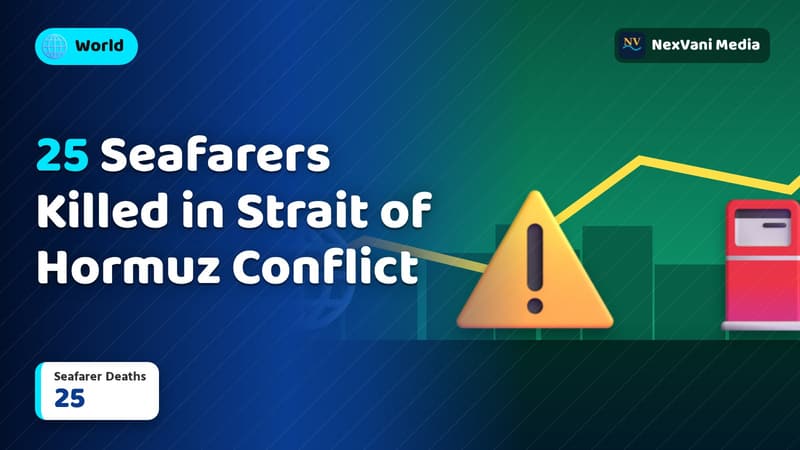
UN Reports 25 Seafarers Killed in Strait of Hormuz Since US-Israel War on Iran
Illustration: NexVani Media
The United Nations reports that 25 seafarers have died in the Strait of Hormuz since the conflict began, as maritime security incidents continue to rise.
The ongoing conflict involving the US, Israel, and Iran has led to a dangerous escalation for commercial shipping, with the United Nations reporting that at least 25 seafarers have been killed in and around the Strait of Hormuz since February. During a UN Security Council briefing, Khaled Khiari, assistant secretary-general for the Middle East, Asia and the Pacific, highlighted that the security situation regarding the Strait of Hormuz US Israel conflict remains critical.
Rising maritime security threats
The International Maritime Organization (IMO) has documented 136 security incidents involving vessels in the region between March 1 and November 11. October saw the highest frequency of these events, with 35 recorded incidents, followed by 10 in early November. Khiari emphasized that these occurrences are unacceptable, noting that civilian and commercial vessels must not be treated as targets in the ongoing hostilities.
Recent reports from Iranian authorities indicate that three oil tankers caught fire after striking naval mines while navigating through areas Tehran has designated as restricted. The Iranian navy has issued warnings that any vessels entering these zones without prior authorization face the risk of being targeted by mines. Tehran maintains that the waterway will remain closed until several conditions are met, including the lifting of economic sanctions, the release of frozen funds, and an end to the US naval blockade of its ports.
Conversely, the US military asserts that it has successfully cleared the primary shipping routes of mines and maintains that the waterway is open for commercial transit. Despite these claims, data from the United Kingdom Maritime Trade Operations (UKMTO) shows that shipping activity through the strait has plummeted to approximately 65 percent below pre-war levels.
At least 25 seafarers have died in maritime incidents near the Strait of Hormuz since February.
Khiari warned that the current maritime environment is both unpredictable and expensive. The persistent disruptions have triggered significant global economic consequences, contributing to higher energy, transport, and insurance costs. Furthermore, these challenges are fueling inflation and threatening global food security by hindering the shipment of essential fertilizers.
Why it matters
The inability to safely navigate this vital waterway threatens global supply chains and increases costs for energy and food. For nations reliant on imported fuel and fertilizers, the instability in the region exacerbates economic pressures and poses a direct risk to national food security.
This situation represents a significant departure from international maritime norms. As the UN seeks a full restoration of navigation, the ongoing conflict continues to impact global trade, forcing vessels to avoid the area or face extreme danger.
Sources
More like this

Pact on South China Sea code of conduct unlikely as ASEAN leaders gather

Jordan sentences three men to death for fatal church attack

Israel Kills Hamas Commander in Strike on Gaza Camp