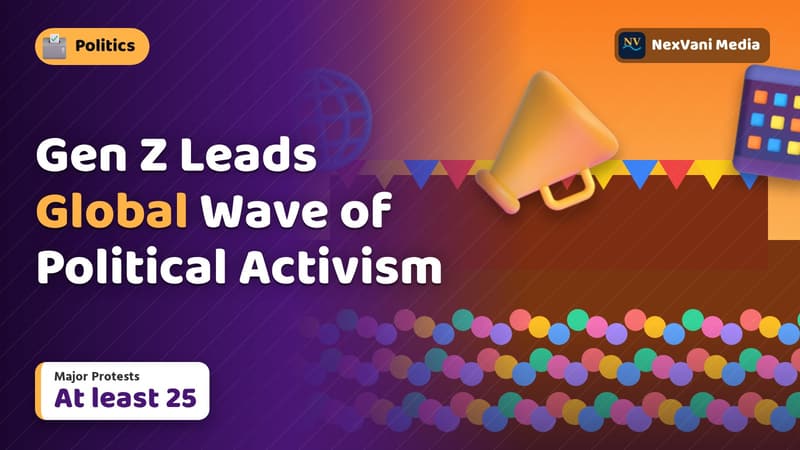
Gen Z Protests Signal a Global Political Awakening Against Authoritarianism
Illustration: NexVani Media
Young people across the globe are driving a wave of political activism, challenging established power structures and demanding systemic change in governance.
A significant demographic shift is currently reshaping the world, as Gen Z activists spearhead a global political awakening. From Bangladesh to Belgium and Italy to India, young people—who comprise roughly one-third of the world’s population—are increasingly unwilling to remain on the sidelines as political systems fail to address their grievances. While these movements often operate within a volatile global market, the primary driver for these protests is a fundamental breakdown of the social contract.
Researchers have identified at least 25 major protests involving individuals aged 14 to 29. Their motivations are diverse, ranging from demands for affordable housing and climate action to protests against corruption and restricted education. In 2024, students in Dhaka, Bangladesh, successfully led a revolution that culminated in the resignation of Prime Minister Sheikh Hasina. Similarly, in Serbia, student-led movements recently ousted long-term leader Aleksandar Vučić, ending 14 years of his party's governance.
Digital Mobilization and Grassroots Power
Unlike historical movements, today's activism relies on a sophisticated digital infrastructure. Platforms like TikTok and X amplify grievances, while Discord servers and encrypted group chats facilitate decentralized planning. This connectivity proved decisive in Brazil’s recent presidential election, where students mobilized in support of Luiz Inácio Lula da Silva, creating a digital network that reached millions. Analysts note that this combination of street presence and social media strategy allows organizers to circumvent state-imposed internet shutdowns.
Gen Z is leading a global movement to challenge authoritarianism and demand systemic political reform.
Despite their focus on democratic ideals, these youth-led movements frequently face intense state repression. In India, the 'Cockroach' movement, which uses satire to challenge the government, has been met with mass detentions and the use of force by security personnel. Similarly, reports from Bangladesh and France highlight the severe physical toll on young protesters, with UN experts noting thousands of injuries and fatalities resulting from state-led crackdowns. Civicus, a non-profit monitoring civic freedoms, suggests that this violence stems from the movement's direct challenge to the distribution of economic and political power.
Why it matters
This trend represents a fundamental shift in how political change is achieved. By targeting the systems that have long governed international order, Gen Z is forcing a re-evaluation of institutional legitimacy across Asia, Europe, and beyond.
For readers in India and South Asia, this movement highlights the growing tension between strongman governance and youth-led democratic participation. As these protests gain momentum, they signal an era where traditional political barriers are increasingly vulnerable to decentralized, tech-savvy activism.
Sources
More like this

Abdul El-Sayed's Journey from Oxford to Michigan Senate

Victorian Liberals campaign bus crash marks end of a difficult week
US Midterms: Can Trump work with Democrats or will he rely on the veto?