Nasa's Neil Gehrels Swift Observatory to Re-enter Earth
Nasa's Neil Gehrels Swift Observatory is set to re-enter Earth's atmosphere on Wednesday after two decades of studying cosmic explosions.
The Neil Gehrels Swift Observatory, which has spent two decades studying some of the most powerful explosions in the universe, is on an uncontrolled trajectory back to Earth. According to Nasa, the spacecraft is predicted to plunge into the atmosphere on Wednesday, with the US Space Force estimating the entry time at roughly 3.30am EST on 4 November. Launched originally in 2004 under the Medium Explorer program, the 3,200lb satellite was only designed to operate with its three telescopes for a period of two years.
Over its extensive operational lifetime, the observatory successfully detected and tracked more than 2,000 gamma-ray bursts, which are recognized as the universe's most intense explosions since the big bang. These flashes of gamma radiation occur approximately once a day from various directions and can last anywhere from a few milliseconds to a few hundred seconds. Scientists continue to theorize about their exact origins, suggesting they may stem from massive stellar explosions creating black holes or the collision of neutron stars.
Earlier this year, the satellite observed a wandering mega black hole destroying a star on the outskirts of a galaxy during a tidal disruption event. Robert Stein, a research fellow at the University of Maryland, College Park and Nasa’s Goddard Space Flight Center, noted that these star-shredding events serve as a method to locate otherwise invisible wandering supermassive black holes. A paper published in The Astrophysical Journal Letters detailed that the event briefly radiated with the light of roughly 10 billion suns.
Last year, an attempt by Nasa to push Swift into a higher orbit using a private space contractor failed because the rendezvous could not be completed. By last month, the spacecraft was orbiting roughly 171 miles above Earth and officials commanded it to end operations. Nasa reports that most of the spacecraft will burn up upon re-entering the atmosphere, though certain components are expected to survive. The agency stated that surviving fragments will land between 20.6 degrees south latitude and 20.6 degrees north latitude, noting that the risk of harm to anyone on Earth is approximately 1 in 2,100.
Nasa spacecraft to re-enter Earth's atmosphere in an uncontrolled descent on Wednesday.
Why it matters
The uncontrolled re-entry of the Neil Gehrels Swift Observatory marks the conclusion of a historic mission that fundamentally transformed our understanding of cosmic phenomena. While the risk of ground impact remains low, the event signifies the final chapter for a satellite that broadened astronomical knowledge regarding active galaxies, supermassive black holes, and supernova explosions.
Sources
More like this
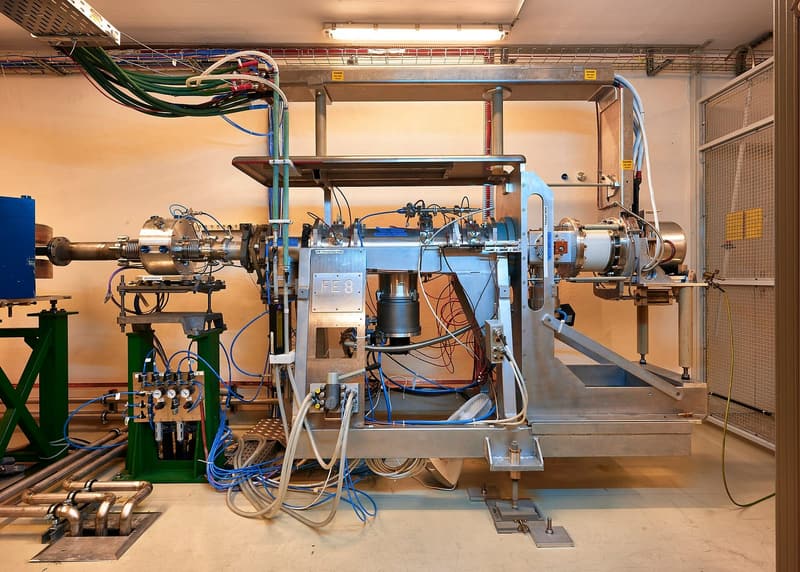
Scientists detect dark matter clues at the smallest scale ever explored

Fossilised Red Blood Cells Found in 115-Million-Year-Old Dinosaur
Anthrax outbreak kills dozens of hippos in DR Congo park