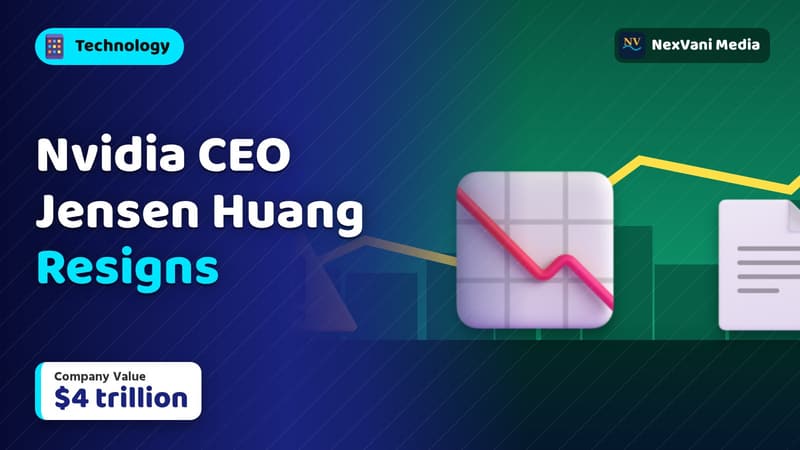
Nvidia's CEO Jensen Huang Resigns Following Affair Allegations
Illustration: NexVani Media
Nvidia co-founder Jensen Huang has resigned following allegations of two affairs, shaking the microchip giant and raising fresh uncertainty across global financial markets and the race for artificial intelligence.
Nvidia's CEO Jensen Huang has resigned from the microchip giant he helped establish, stepping down after back-to-back revelations regarding two personal affairs shook the company. The 63-year-old executive faced intense scrutiny after reports emerged on Wednesday that he had engaged in an affair with a company executive, coming days after disclosures surfaced detailing a romantic relationship with a woman alleged to be a spy for China.
The consecutive allegations caused Nvidia's shares to sink. The departure leaves fresh uncertainty across the global stock market, which leans heavily on the firm's processors, and raises concerns over the future of an enterprise viewed as a linchpin in the American race for artificial intelligence dominance over China.
Jensen Huang has resigned from Nvidia following revelations of two affairs, shaking global markets and the artificial intelligence industry.
The Fall of Nvidia's CEO Jensen Huang Prior to his resignation, Huang was riding the crest of the AI boom, which he described as a new industrial revolution comparable to electricity. Valued at more than $4 trillion, Nvidia manufactures the industry's premier microchips. Huang amassed an estimated fortune of $145 billion, according to the Bloomberg Billionaires Index, earning the label "Taylor Swift of tech." Stephen Witt, author of the biography Thinking Machine, told the BBC that Huang was a visionary comparable to Steve Jobs who created modern AI hardware.
Born in Taiwan in 1963, Huang moved to the US west coast at age nine. He studied electrical engineering at Oregon State University, meeting his future wife Lori Mills as a college lab partner. They married in 1985, eight years before he co-founded Nvidia following a stint at chip firm AMD. His children, Madison and Spencer, both work at the firm. Although known as a demanding workaholic, Huang strove for decades to present himself as a family man who embodied the American Dream.
Huang maintained exceptional political access, meeting Chinese President Xi Jinping and standing alongside Elon Musk to flank US President Donald Trump at a White House AI summit. Nvidia's sprawling customer base includes Amazon, Google, Meta, Microsoft, OpenAI, Anthropic, Tesla, and SpaceX.
Why it matters Huang's sudden exit introduces instability into global financial markets and the broader technology ecosystem. Because the world's largest companies rely heavily on Nvidia's microchips, any sustained disruption at the firm could have wider economic consequences.
The leadership vacuum also impacts the competitive balance between the United States and China, where Nvidia serves as an essential technological linchpin. The rapid collapse of Huang's standing destabilizes the corporate core driving the global artificial intelligence expansion.
Sources
More like this
China Calls Nvidia Spy Claims a Pretext for Tech Blockade

Al Jazeera interviews robot about the future of artificial intelligence

UK Drone Maker UForce Hits £4.5bn Valuation After Raising £500m