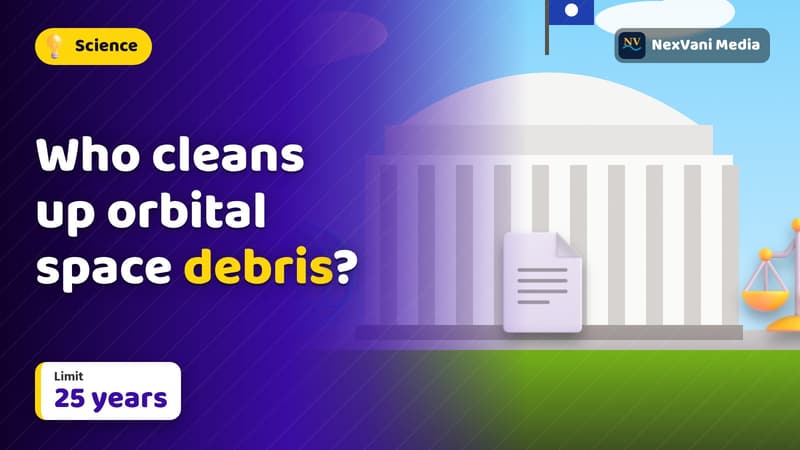
Who is responsible for managing and cleaning up orbital space debris?
Illustration: NexVani Media
As Earth's orbit gets increasingly congested with defunct satellites and rocket fragments, the global space industry faces a growing challenge over who must clean it up.
Space is getting busier. Every year, more satellites are launched to support communications, navigation, weather forecasting, and Earth observation. The problem is that not everything sent into orbit comes back down. Thousands of defunct satellites, discarded rocket stages, and fragments from past collisions are now travelling around Earth at enormous speeds, posing a continuous threat to operational spacecraft where even a small piece of debris can cause severe damage.
International space law provides a starting point through the 1967 Outer Space Treaty and the 1972 Liability Convention. These agreements establish that countries are responsible for their national space activities and hold states liable for damage caused by space objects. However, neither treaty mandates the removal of old satellites or the clearing of space debris. Consequently, there is no clear international system requiring countries or companies to clean up after themselves, leaving prevention as a more practical strategy than trying to remove everything already in orbit.
Regulators are stepping up efforts to address the issue. The United Nations Committee on the Peaceful Uses of Outer Space encourages operators to minimise debris, avoid collisions, and dispose of spacecraft safely. Meanwhile, NASA recommends removing certain spacecraft within twenty-five years of mission completion, and the US Federal Communications Commission introduced a five-year limit in 2022 for specific satellites in low Earth orbit.
Who is responsible for clearing space debris
Removing orbital waste involves significant technological and legal hurdles. Satellites are rarely designed to be collected once inactive, and approaching a fast-moving object requires advanced technology, as demonstrated by the European Space Agency's ClearSpace-1 mission. Furthermore, space objects remain under the jurisdiction of their state of registry, meaning permission is generally required before another party can remove them, and liability concerns remain if a removal attempt creates further debris.
Financial responsibility is another major unanswered question. A polluter-pays approach could place more accountability on debris creators and encourage better end-of-life planning, but implementing such a system requires global agreement on funding, liability, and enforcement.
Preventing additional space debris is currently more practical than trying to remove everything already in orbit.
Why it matters
Global infrastructure relies heavily on reliable satellite services for aviation, telecommunications, navigation, and weather forecasting. A growing orbital debris problem directly threatens these vital systems, making international cooperation among governments, regulators, and operators essential to protect Earth's limited orbital regions.
Sources
More like this

Non-Venomous Python Rescued From Jalpally Road in Hyderabad
NASA Accelerates Moon Landing Timeline to 2028 in New Astronomy News
NASA Voyager 1 Reaches Historic Milestone of One Light-Day from Earth