
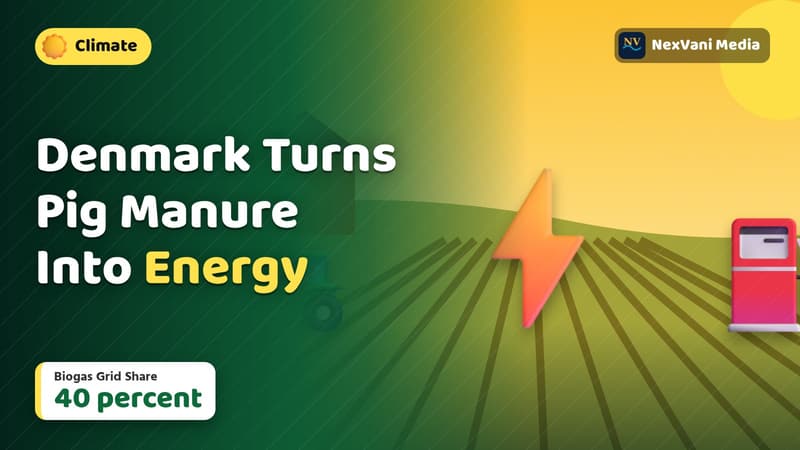
Powering the future: Denmark turns pig manure into national energy
Illustration: NexVani Media
Denmark is scaling up biogas production by converting millions of tonnes of livestock manure into renewable energy, aiming for a carbon-neutral grid.
As the world seeks to reduce carbon emissions, Denmark is increasingly Powering the future by transforming livestock waste into renewable natural gas. With a pig population that dwarfs its human inhabitants, the country has turned a significant waste management challenge into a cornerstone of its energy transition. By converting manure into biogas, Denmark now boasts the highest share of biogas in its national gas grid in Europe, reaching approximately 40 percent.
Scaling up industrial biogas
Over the last decade, Denmark has expanded its infrastructure from small-scale operations to roughly 150 industrial-sized plants. These facilities rely on pig and cattle slurry for up to 70 percent of their raw materials. In the southern town of Sonderborg, the ProjectZero initiative has been instrumental in this shift. Since 2007, the project has integrated renewables and industrial waste heat to cut energy-related carbon emissions by 79 percent, with the goal of achieving a fully carbon-neutral system by 2029.
Denmark is converting millions of tonnes of livestock waste into biogas to power its national energy grid.
Despite these advancements, the strategy faces criticism. Environmental groups like NOAH Friends of the Earth Denmark argue that this reliance on manure incentivizes factory farming and hinders the transition to wind or solar energy. Critics suggest that the current approach locks in pollution rather than phasing out intensive livestock production. Conversely, industry advocates maintain that biogas provides essential energy security and helps farmers manage unavoidable agricultural emissions.
Innovation in agricultural carbon capture
To prepare for a 2030 carbon tax on agriculture, farmers are testing new technologies. At Grasten Agricultural College, researchers are using carbon capture units to extract CO2 from biogas combustion. This captured carbon can then be sold for industrial use, such as food processing or beverage carbonation, turning a waste product into a marketable commodity. Principal Bjarne Ebbesen views this as a way for the agricultural sector to become part of the climate solution rather than the problem.
Why it matters
This shift represents a major change in how agricultural waste is managed, turning a polluting byproduct into a vital energy resource. It impacts the farming community directly by creating new revenue streams through carbon capture, while providing the nation with greater energy independence amidst volatile global fuel markets.
Sources
More like this

Clean-up of Illegal Mobuoy Dump Estimated to Cost £161m Over Three Decades

Red Crabs Migration Begins on Christmas Island
Russia, Saudi Arabia and Australia named as top CO2 exporters in history
