How the Houthis fund their war effort and tighten control in Yemen
Illustration: NexVani Media
The Houthi movement in Yemen has developed a sophisticated financial network to sustain its military operations while public services and living conditions for civilians continue to decline.
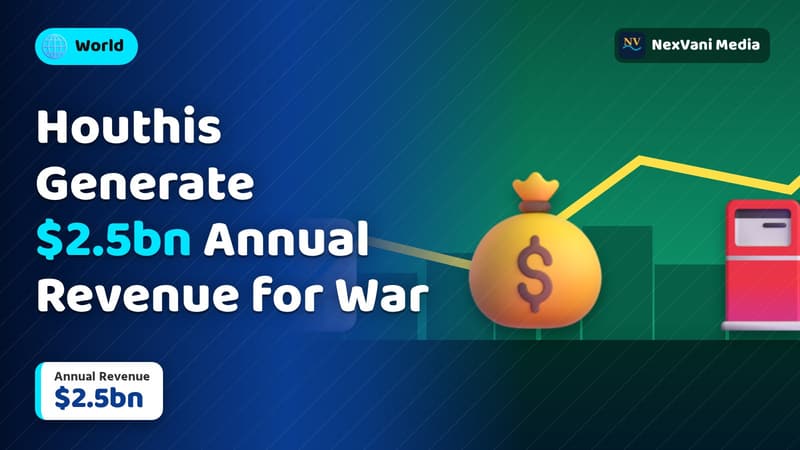
Understanding how the Houthis gained military power requires examining the complex financial systems the group has built over a decade of conflict. Operating from Sanaa, the movement has established a self-reinforcing cycle where economic control facilitates coercion, which in turn strengthens their grip on local resources. According to the Mokha Center for Strategic Studies, this financial apparatus generates an estimated $2.5bn in annual revenue through taxes, customs, and various levies.
Financial streams and public contributions
The group’s revenue is diverse, ranging from formal taxation to informal public solicitations. Research indicates that approximately 60 percent of these funds are directed toward military and security sectors. Beyond institutional taxes, residents report being pressured to contribute to the war effort through mobile phone campaigns and voluntary envelopes distributed during public gatherings. These small, individual donations, when aggregated, provide millions in additional funding for missile and drone development.
International support also plays a role in the group’s economic stability. The US Department of the Treasury has reported that Iranian-affiliated entities have facilitated oil shipments to the Houthis, generating over $2bn annually through illicit sales. This influx of capital allows the movement to maintain a large force of approximately 350,000 fighters, even as the broader Yemeni population faces severe economic hardship.
The Houthi financial system leverages economic control to fund military expansion while deepening civilian poverty.
The cost of militarization
For many young men in Yemen, joining the Houthi forces has become one of the few available sources of income amid a landscape of unpaid public-sector salaries and limited employment. This recruitment is often paired with ideological training, which integrates the movement's influence into families and communities. While the group invests heavily in fortifications, tunnels, and advanced weaponry, civilian institutions like health and education suffer from chronic underfunding. With roughly 80 percent of the population living below the poverty line, the priority placed on the war effort continues to exacerbate the humanitarian crisis, leaving over 22 million people dependent on aid.
Why it matters
The Houthi movement’s ability to sustain its military operations through a mix of domestic levies and illicit oil sales ensures the conflict remains protracted. This ongoing militarization directly impacts the stability of the Red Sea region, affecting global supply chains and regional security. For the Yemeni population, the diversion of resources toward the security apparatus means that basic services will likely remain in a state of deterioration for the foreseeable future.
Sources
More like this

As Trump Arrives in China, Low Expectations for Breakthroughs in Rivalry
Piecemeal wars: A new kind of global conflict is already under way

What Deutsche Bank Leaks Reveal About Trump, Epstein and Russia