Journalism and AI: Who Owns the News and Powers Chatbots?
Illustration: NexVani Media
As millions of users turn to AI chatbots for current events, media organizations are demanding fair compensation and stronger copyright protections.
Millions of people worldwide now rely on artificial intelligence chatbots to source quick answers regarding current news and global events. Traditional journalism has long been responsible for explaining what is happening, why it matters, and what it means by dispatching reporters into the field, funding investigations, and conducting rigorous research. However, the balance between news producers and digital distributors is shifting rapidly as audiences bypass traditional websites in favor of direct AI summaries.
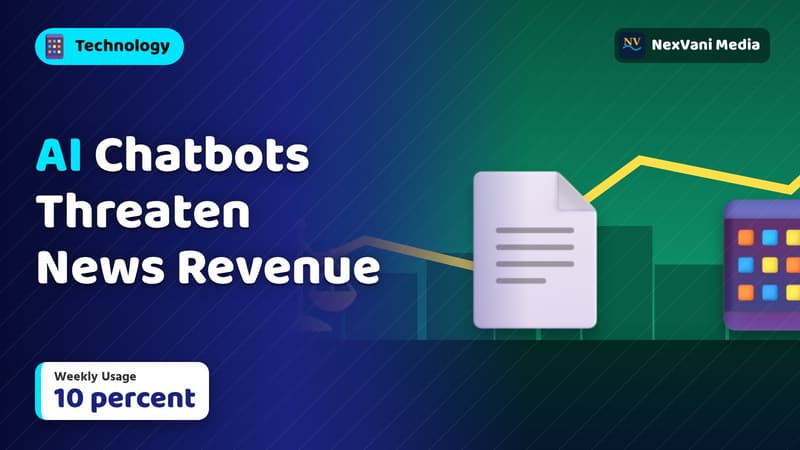
According to a 2026 survey by the Reuters Institute for the Study of Journalism encompassing over 90,000 respondents globally, 10% access news through AI chatbots on a weekly basis, with much higher adoption rates among younger demographics. While traditional search engines historically directed web traffic to publisher websites, AI chatbots aggregate reporting internally. Media executives warn that this exchange has broken down, leaving underlying reporting invisible and uncompensated.
Industry leaders at the Global Media Forum in Berlin raised urgent alarms over copyright violations and lost revenues. DW Director General Barbara Massing emphasized that AI systems utilize high-quality reporting without providing adequate visibility or financial return, asserting that AI tools must pay for the journalism they depend upon. Similarly, Julia Becker of Funke Media Group noted the decline of traditional referral traffic. Media houses across Europe and the United States are actively pushing major technology firms to secure prior permission and establish direct payment structures.
AI chatbots use professional journalism to answer questions while starving publishers of necessary traffic and revenue.
Legal pressures are mounting globally. German broadcasters ARD and RTL, alongside publisher associations BDZV and VAUNET, have demanded enhanced copyright protections. In the United States, legal battles target unauthorized content usage, while European Union institutions investigate whether AI-generated responses directly infringe copyright. Experts like Professor Martin Senftleben suggest that existing European copyright laws could facilitate collective remuneration models, similar to established music royalty systems, where every AI response utilizing journalism triggers a financial distribution.
Tech companies are beginning to respond to these economic and legal pressures. Google has initiated preliminary pilot programs aimed at rewarding publishers whose content heavily influences AI summaries, though industry stakeholders stress that systematic solutions remain necessary. Meanwhile, other tech entities including Microsoft, Anthropic, and OpenAI express support for clearer, standardized website signals to manage training permissions.
Why it matters
The ongoing debate over AI-generated news directly impacts the sustainability of independent reporting worldwide. As automated tools absorb professional media content without returning adequate traffic or financial support, the future viability of field journalism faces serious economic threats.
Sources
More like this

DataVita Revises Lanarkshire AI Datacentre Energy Plans to Rely on National Grid

TikTok accused of helping to promote the sex industry to young users

Canada Palantir Deal Raises Military Data Exposure Concerns