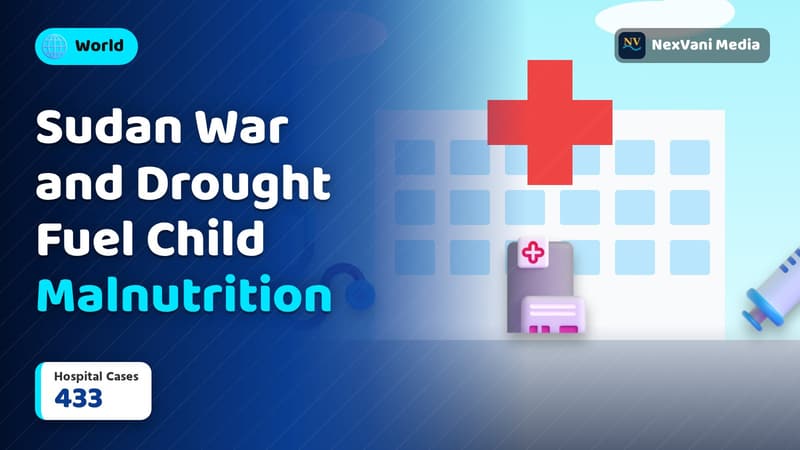
Sudan War and Climate Crisis Drive Severe Child Malnutrition
Illustration: NexVani Media
Children across Sudan face rising malnutrition driven by ongoing civil war, displacement, and climate-induced drought.
Layla Ali travelled two and a half hours from al-Lalouba village to Port Sudan to seek medical help for her five-year-old son, Adam, whose severe malnutrition left his ribs visibly protruding. Initially hesitant due to the distance and treatment costs, Ali brought him to the hospital when his condition worsened significantly. After a five-day stay receiving treatment, Adam's situation highlights a broader crisis across Sudan, where a civil war between the Sudanese Armed Forces and the Rapid Support Forces continues unabated since April 2023.
Experts note that the ongoing conflict, alongside climate change and the El Nino phenomenon, has severely disrupted food security and agriculture. The Integrated Food Security Phase Classification estimates that 825,000 children under five will suffer from severe acute malnutrition in 2026. In the first six months of the year, UNICEF and partners treated 174,700 children nationwide, while Port Sudan Teaching Hospital recorded 433 cases between January and August. Medical staff face severe overcrowding, housing up to three children in a single bed within the malnutrition unit, which heightens the risk of spreading infectious diseases among vulnerable patients.
War, climate change, and displacement are fueling an escalating child malnutrition crisis across Sudan.
The Regional Impact of the Sudan War
The crisis is particularly acute in regions like Darfur, which has endured decades of conflict and currently serves as an RSF stronghold. In North Darfur alone, UNICEF reported at least 40,000 malnutrition cases between January and May 2025 during an RSF siege on el-Fasher. Meanwhile, in Blue Nile State, the al-Karama 3 displacement camp in al-Damazin saw malnutrition cases rise from 1,800 in September to 2,116 in November, affecting over a quarter of the camp's children.
Climate factors are compounding the devastation. Reduced rainfall from the El Nino phenomenon has caused droughts affecting roughly half of the country, leading to poor vegetation growth on nearly two-thirds of farmland in North Darfur and about half in South Darfur and Kordofan states. Additionally, rising numbers of flies and mosquitoes are spreading diseases that worsen malnutrition among already vulnerable children.
Why it matters
This crisis directly affects millions of vulnerable civilians, particularly displaced women and children who face extreme humanitarian conditions, hunger, and disease. The combination of armed conflict and climate-driven drought threatens harvests and accelerates food insecurity across multiple regions in Sudan.
Sources
More like this

Ukraine Russia war: Strikes hit Kyiv ahead of talks
Trump Iran War: Mixed Signals as US President Weighs Next Steps

Russia Strikes Kyiv Bridge and Energy Grid Ahead of Abu Dhabi Talks