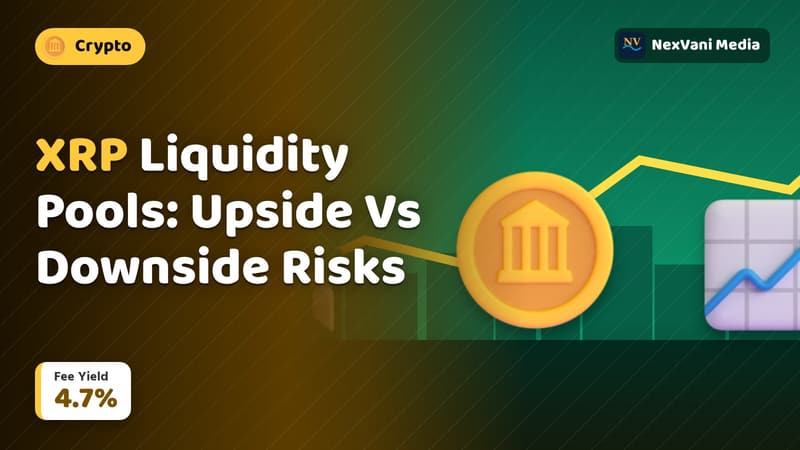
XRP could double while liquidity pool strategy changes asset exposure
Illustration: NexVani Media
Exploring the XRPL liquidity pool pairing XRP and RLUSD reveals how automated rebalancing cushions downside risks while altering upside exposure compared to holding pure XRP.
This is news, not investment advice. NexVani Media is not a SEBI-registered investment adviser and does not recommend buying or selling any security. Do your own research or consult a registered adviser before investing.
A native liquidity pool on the XRP Ledger pairing XRP with Ripple’s dollar stablecoin, RLUSD, currently quotes an annualized trading-fee yield of about 4.7%. Entering this pool alters what a digital asset holder actually owns by transforming the position into a shifting mix of XRP and the stablecoin. This dynamic surrenders a portion of potential gains if XRP could double, while simultaneously providing a cushion during market declines. Data from XRPL.to on November 7 captured XRP trading near $1.16, which marked a 7.1% decrease over seven days.
At the time of data collection, the specific liquidity pool held roughly 1.94 million XRP and 2.25 million RLUSD, displaying a seven-day fee estimate of 0.09% for the week. Under constant-product mechanics, trading activity changes the precise quantities of XRP and the dollar stablecoin represented by liquidity-provider tokens. Fees accumulate within the pool, becoming part of the assets that these tokens can redeem. However, these figures serve as estimates rather than a guaranteed reconstruction of actual realized income throughout the week.
Assessing XRP price movements and portfolio outcomes
Comparing this liquidity strategy against benchmark holdings involves looking at equal initial investments. In a hypothetical model assuming RLUSD remains fixed at $1 without costs, a 20% rise in XRP leaves the pool valued at approximately $10,954, compared to $11,000 for an untouched 50/50 allocation and $12,000 for holding pure XRP. Conversely, a 20% drop in XRP leaves the modeled pool worth about $8,944, outperforming the $8,000 value of an all-XRP position.
Larger price swings widen this rebalancing gap. If XRP doubles in value, the modeled pool reaches $14,142, trailing an untouched 50/50 mix at $15,000 and an all-XRP holding at $20,000. On the downside, halving XRP results in pool values of $7,071 compared to $7,500 and $5,000 respectively. Furthermore, introducing RLUSD carries separate risks, as Ripple's terms permit freezing and blacklisting under specific legal and compliance conditions.
Providing liquidity alters asset exposure by trading potential upside gains for downside cushioning.
Why it matters
This fee estimate and portfolio dynamic highlight the trade-offs participants face when supplying native assets to automated market makers. By shifting between digital tokens and stablecoins, holders modify their risk profiles rather than securing straightforward returns, making it essential to compare strategy yields against holding benchmarks over matched periods.
Sources
More like this

CFTC Demands Exchanges Remove Geographic Restrictions on Kalshi Bets

Stablecoin Growth Stalls Even as Blockchain Payments Surge
The catch with recovering a hacked crypto wallet: thieves may hold keys